Why Your 'Minimalist' Home Still Feels Empty: Rethinking What We Keep

We've been sold a fiction—that less automatically equals more. The minimalist movement promised serenity through subtraction, yet countless people find themselves staring at sparse rooms wondering why the calm never arrived. The problem isn't the quantity of what surrounds you. It's the quality of your relationship with those things.
This isn't another guilt trip about consumerism or a pep talk for decluttering marathons. Instead, we're examining the psychology of possessions—why we hold on, what our objects actually communicate, and how to build a physical environment that genuinely supports who you are (not who Instagram thinks you should be). The goal isn't a perfectly staged living room. It's a space that functions as an extension of your identity, curated with the same intention you'd apply to any meaningful relationship.
What Makes a Physical Object Meaningful Versus Just Taking Up Space?
Researchers at UCLA's Center on Everyday Lives of Families spent years documenting how Americans actually live—not how they claim to live. Their findings were striking: the average home contains hundreds of items the occupants can't identify with any specificity. These aren't cherished heirlooms. They're the residue of indecision, guilt, and aspirational purchasing that never panned out.
Meaningful objects share common characteristics. They carry narrative weight—a story you can articulate without hesitation. They serve a genuine function in your daily rituals. Or they spark what psychologists call 'positive affect,' a reliable emotional response that sustains over time (not just the dopamine hit of acquisition).
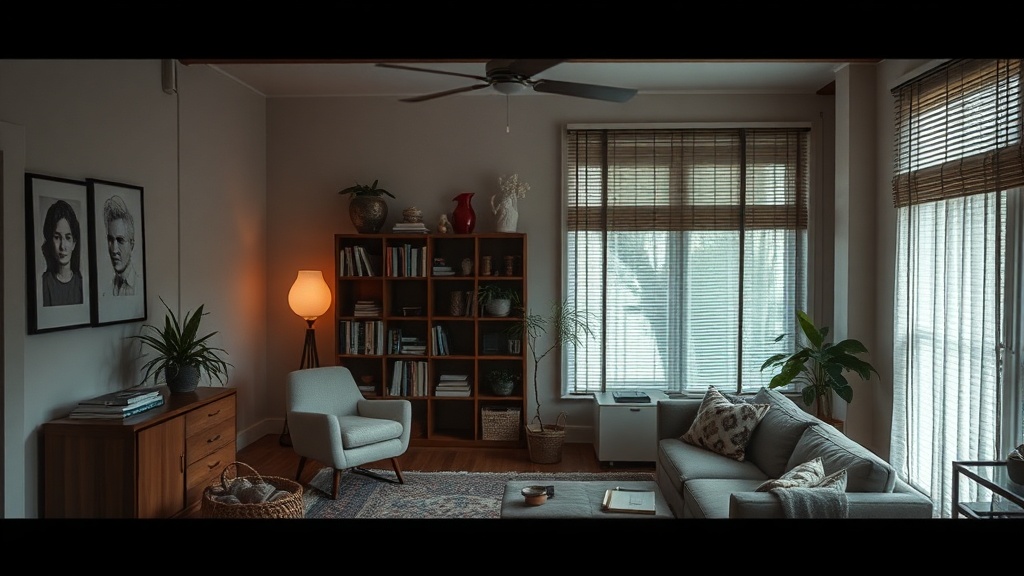
The key distinction? Intentionality. A crowded bookshelf filled with annotated volumes you've actually read holds more value than a single 'statement' vase purchased because a designer recommended it. Your grandmother's chipped teacup outperforms the perfectly matched set you bought during a 3 AM anxiety spiral. The metric isn't volume—it's coherence with your actual life.
Do Our Possessions Actually Shape Our Identity, or Just Reflect It?
Here's where conventional wisdom gets it backward. We treat our belongings as passive mirrors of who we already are. In reality, the relationship is bidirectional—our environment actively constructs our sense of self. Consumer psychologists have documented this phenomenon extensively: the extended self theory proposes that we literally incorporate possessions into our identity.
This explains both the attachment to meaningful objects and the embarrassment about clutter we haven't addressed. Your space isn't just background scenery—it's a continuous feedback loop telling you who you are. When that message conflicts with your self-concept (the aspirational yoga mat gathering dust, the unread philosophy books signaling intellectualism you haven't earned), it creates a specific type of cognitive dissonance that manifests as background stress.
The solution isn't purging everything that doesn't 'spark joy' (a phrase that's been commercialized beyond recognition). It's developing a more honest dialogue between your identity and your environment. What do these objects say about your priorities? About your fears? About the gap between your aspirational self and your actual behavior?
How Do You Decide What Stays Without Falling Into 'Just in Case' Traps?
Storage units in the United States now occupy more square footage than the combined footprint of every McDonald's, Starbucks, and Pizza Hut in the country. We've outsourced our indecision—paying monthly rent for objects we can't commit to keeping or releasing. The 'just in case' rationale has become a collective reflex, enabled by cheap storage solutions and the psychological weight of sunk costs.
Breaking this pattern requires a more rigorous decision framework. The 20/20 rule popularized by minimalist practitioners suggests that if you can replace an item for under $20 in under 20 minutes, it's not worth the mental real estate. But this only addresses utilitarian objects. What about the ambiguous category—gifts from ex-partners, inherited furniture, hobby supplies for projects abandoned years ago?
For these trickier cases, try the 'photograph and release' method. Research on psychological ownership shows that we often cling to objects as memory triggers. A photograph preserves the narrative without the physical burden. The inherited china you never use but feel obligated to keep? Document it, note its provenance, donate it to someone who will actually host dinner parties. The memory persists; the guilt evaporates.
Why Do We Buy Things We Know Won't Make Us Happy?
The prediction error driving impulse purchases has been well-documented by behavioral economists. We systematically overestimate the emotional duration of acquisition—imagining weeks of satisfaction when the reality is often hours. What gets less attention is the function these purchases serve beyond the object itself.
That skincare haul during a stressful work week? Probably less about skin health and more about regaining a sense of control. The furniture bought during a breakup? An attempt to reshape your environment when your life feels unmoored. Recognizing these patterns doesn't require eliminating the behavior—it requires honesty about what you're actually shopping for.
Before any non-essential purchase, implement the 'three why' interrogation. Why do I want this? (First answer: because it's beautiful.) Why does that matter right now? (Second answer: because my apartment feels depressing.) Why does my apartment feel depressing? (Third answer: because I've been isolating and need social connection.) Suddenly the $400 lamp becomes obviously inadequate for the actual need.
Can a Small Space Feel Intentional Without Looking Like a Design Catalog?
The aesthetics of intentionality have been thoroughly co-opted. Scroll through any design-focused platform and you'll see the same signifiers: neutral palettes, natural materials, abundant negative space, a single 'quirky' accent that screams calculated personality. These spaces are often beautiful. They're also frequently uninhabited—styled for photography rather than living.
Real intentionality looks messier. It accommodates the evidence of actual hobbies—the musical instrument in the corner, the half-finished craft project, the stack of library books with due dates. It prioritizes function over form in the spaces where you actually spend time. The kitchen that supports your cooking practice matters more than the entryway that impresses visitors.
Start with the question: what does this room need to do for me? Your bedroom needs to support sleep and intimacy. Your workspace needs to facilitate focus. Your living room needs to accommodate the specific ways you actually relax (not the way a lifestyle magazine assumes you relax). Design from function outward, not from aesthetic backward.
What's the Difference Between Curating and Simply Accumulating?
The language of curation has been diluted through overuse. Every carefully arranged coffee table isn't a curation—sometimes it's just shopping with a color scheme. True curation implies selection according to specific criteria, ongoing refinement, and a coherent narrative thread.
A curated wardrobe isn't defined by capsule-count minimalism. It's defined by interoperability—pieces that work together in multiple combinations, that suit your actual life (not your fantasy one), that have been tested through wear and proven durable. A curated bookshelf isn't defined by impressive spines but by genuine engagement—the ratio of read to unread, the connections between volumes, the absence of performative display.
The practice is ongoing, not episodic. Set calendar reminders for quarterly reviews—not massive purges, but brief audits. What's been used consistently? What's been ignored despite good intentions? What no longer aligns with who you're becoming? This rhythm prevents the accumulation that turns curation back into clutter.
How Do You Maintain Intentionality When Marketing Never Sleeps?
The average person encounters thousands of commercial messages daily. Algorithms have become extraordinarily sophisticated at identifying and exploiting our specific vulnerabilities. Maintaining intentionality isn't a one-time decision—it's an active practice of resistance against well-funded persuasion.
Build friction into your purchasing process. Delete saved payment information. Implement mandatory waiting periods for non-essential items. Unsubscribe from promotional emails that trigger impulse responses. These aren't ascetic deprivations—they're structural supports for your actual priorities.
More importantly, develop alternative sources of the satisfactions that consumption promises. If you shop when bored, build a list of genuinely engaging alternatives. If you buy to self-soothe, develop more effective regulation strategies. The goal isn't perfection—it's proportion. Some purchases will still be impulsive, some objects will still disappoint. The aggregate trend is what matters.
Your space should evolve with you, not against you. The objects you choose to surround yourself with are votes for the person you're becoming—cast them deliberately.